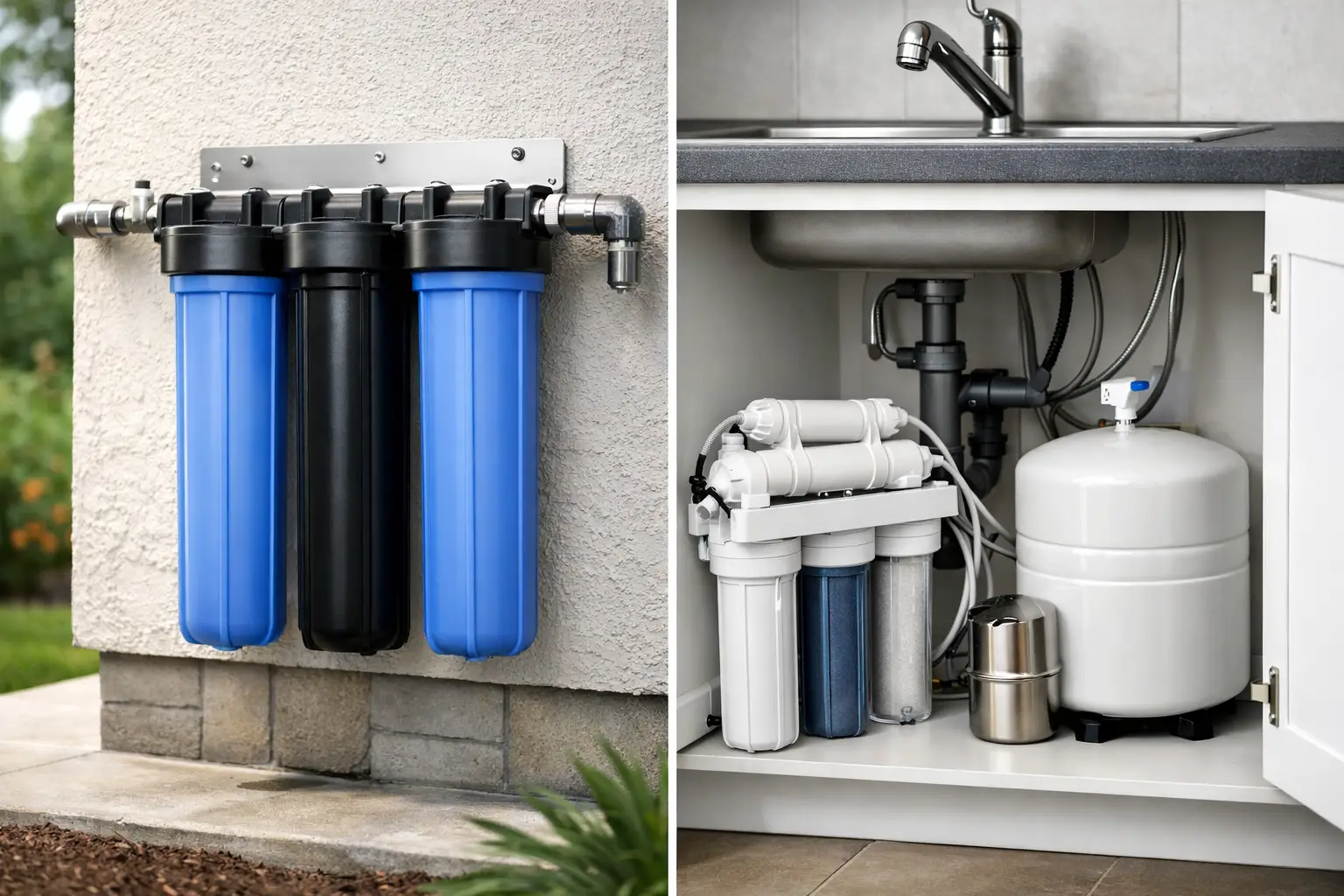
You notice it in small ways first. Chlorine smell in the shower. White scale around taps. Drinking water that tastes flat unless it is chilled. When homeowners compare whole house filter vs reverse osmosis, they are usually trying to solve more than one problem at once – and that is where the choice matters.
The short answer is simple. A whole-house filter treats water as it enters your home, so every tap, shower and appliance benefits. Reverse osmosis treats water at a single point, usually the kitchen sink, and is designed mainly for drinking and cooking water. Neither system is automatically better in every home. The right fit depends on what is in your water, what outcomes matter most to your household, and whether you want a whole-home solution or a drinking-water upgrade.
Whole house filter vs reverse osmosis: what is the real difference?
A whole-house filtration system is a point-of-entry system. It is installed on the main water line so it can reduce sediment, chlorine, organic matter and, depending on the setup, some scale-forming contaminants before the water reaches the rest of the home. That means filtered water for showers, bathrooms, laundry, kitchen taps and connected appliances.
Reverse osmosis is a point-of-use system. It sits under a sink and pushes water through a fine membrane to remove a very high percentage of dissolved contaminants, including salts, heavy metals and other fine impurities. The result is highly purified water, but only at that outlet.
That difference affects everything else – cost, convenience, maintenance, water pressure, daily use and the kind of benefit you actually feel.
When a whole-house filter makes more sense
For many Perth and WA households, the concern is not just drinking water. It is the effect water has on everyday living. Chlorine can leave a noticeable smell, hard water can contribute to scale buildup, and sediment can affect plumbing fixtures and appliance performance over time.
A whole-house system is the stronger choice when you want to improve the water experience across the entire property. You are not only thinking about what goes in a glass. You are thinking about what touches your skin and hair, what runs through your hot water system, and what your washing machine, dishwasher and tapware deal with every day.
This is where a properly selected 3-stage setup can be valuable. Different filter media can work together to target sediment, carbon-based impurities and other common water issues in a way that supports both water quality and household performance. For families who want cleaner water throughout the home without managing multiple small systems, this approach is often the more practical and more complete solution.
There is also the convenience factor. One professionally installed system at the entry point is easier for many homeowners than adding separate units around the house. If your priority is broad protection, a whole-house filter usually aligns better with that goal.
When reverse osmosis is the better fit
Reverse osmosis is excellent at one job: producing very high-purity water for drinking and cooking. If your main concern is the quality of water in your glass, kettle or coffee machine, RO can be very effective.
It is especially useful where there are elevated dissolved solids, salinity concerns, or a strong preference for ultra-clean tasting water. In some homes, that level of purification is exactly what is wanted, particularly if someone is sensitive to taste or has specific health-related concerns they are trying to manage under professional advice.
The trade-off is that reverse osmosis does not improve the water in your shower, bathroom basin, laundry or hot water unit. It also produces water more slowly than a standard tap and can waste some water during the filtration process, depending on the unit. That is not necessarily a deal-breaker, but it is worth knowing before you buy.
Whole-home comfort versus tap-by-tap purity
This is often the most useful way to frame the decision. A whole-house filter improves the overall quality and usability of water across the property. Reverse osmosis focuses on achieving a higher purity level at one outlet.
If your family complains about dry skin after showering, staining around fixtures, chlorine smell in bathroom water, or sediment affecting tap performance, reverse osmosis will not solve those whole-home issues. If your only complaint is that kitchen water does not taste as clean as you would like, a whole-house system may be more coverage than you need.
Some households want both. That is not overkill if the water conditions call for it. A whole-house filter can handle broad treatment for daily living, while reverse osmosis can be added under the kitchen sink for premium drinking water. The key is not to install more than you need just because it sounds thorough.
Cost, maintenance and the hidden practicalities
Price matters, but so does what you are paying for. A whole-house system generally has a higher upfront cost than a basic under-sink unit because it is larger, treats more water and usually requires professional installation on the main line. In return, it covers the full home.
Reverse osmosis systems can look more affordable at first, but they only solve one part of the problem. If you later decide you still want better shower water, appliance protection or reduced chlorine throughout the house, you may end up adding a second system anyway.
Maintenance is different too. Whole-house filters usually need periodic cartridge changes based on water quality and household usage. Reverse osmosis systems need filter replacements as well, and the membrane has its own service life. The point is not which one has maintenance, because both do. The point is whether the maintenance matches the value you are getting from the system.
Installation should not be treated as an afterthought. Main-line filtration needs to be fitted correctly to protect flow, comply with plumbing requirements and make future servicing straightforward. For many homeowners, supplied-and-installed service by a licensed plumber removes a lot of uncertainty and gives confidence that the system is doing its job properly from day one.
What Perth homeowners should think about first
Local water conditions shape this decision more than marketing ever will. In Perth, households may be dealing with treated scheme water, bore water, rainwater or a combination, and each source brings different concerns. Chlorine, sediment and hardness-related issues are common discussion points, but the right answer still depends on your property and your goals.
If you are mainly chasing better taste at the kitchen sink, reverse osmosis may be enough. If you want cleaner water for bathing, washing, appliances and drinking, a whole-house system is usually the more sensible foundation. If your water has several challenges at once, a layered approach may be worth considering.
This is why a quick online comparison only goes so far. The better question is not which technology sounds more advanced. It is which system actually addresses the problems you notice every day.
How to choose without overcomplicating it
A practical way to decide is to start with the outcomes you care about most. If you want healthier-feeling showers, less chlorine smell, better protection for plumbing and appliances, and filtered water from every tap, focus on whole-house filtration. If your priority is highly purified water for drinking and cooking at one outlet, focus on reverse osmosis.
If both matter, build from the main line first and then assess whether you still want an RO unit at the kitchen sink. That usually gives homeowners the most balanced result – broad household improvement with the option of extra purification where it counts most.
For families who do not want a DIY project or guesswork around filter selection, getting advice based on your actual water supply is the most reliable path. Aqua Mantra Filters works with homeowners who want that process simplified, with a system that is supplied and installed professionally rather than pieced together later.
The best water filtration choice is the one that fits the way you live. If you want your whole home to feel the benefit, not just one tap, that should guide the decision from the start.